





By Evan Andrade, CHBA Economist
Economic data often lacks the context of what the industry is actually facing. The principal example of this is the historically strong housing starts over the past five years. In January, the annualized housing starts of 254,794 units appears strong, but it does not tell the full story of the changing composition of the types of housing that are being built, and how that’s impacting affordability, especially for ownership, and, in turn, the industry. When we dig deeper into the starts data, we see that over the past five years housing starts for ownership have represented a smaller and smaller share of overall starts. Increased rental housing starts, which represented 51 per cent of total housing starts in 2025, are coming at the expense of starts for homeownership.
CHBA’s Housing Market Index (HMI) provides a much-needed leading indicator about the current and future health of the residential construction industry in Canada with respect to housing units for ownership. In Q4 2025, the HMI recorded new record lows, as builder confidence in new home sales continues to worsen. The single-family index fell 5.5 points to 19.6 in the final quarter of 2025, which was the second consecutive record low and the first time the single-family HMI has fallen below a score of 20. The multi-family index was 14.7 in Q4 2025, down 7.3 points from a year ago and also a second consecutive record low. These results continue to paint an alarming future for new home construction starts and point to a multi-year dearth in starts for freehold or condominium ownership if drastic changes are not made.
Canada’s residential construction sector is very important economically, but there is a lack of data about it, especially compared to existing home sales. That dearth of information was CHBA’s original motivation for creating the HMI. Since its inception in 2021, the discussions the HMI data has generated with policymakers and media have been invaluable to CHBA’s advocacy.
The residential renovation industry also desperately needs this critical market intelligence, so CHBA is working to fill the void.
Over the past five years, the residential renovation sector has seen volatility in annual industry GDP output not seen since the late 1980s and early 1990s. After three years of consecutive declines in output between 2022 to 2024, a modest rebound of just over two per cent in 2025 still puts the industry’s national output at slightly more than $53 billion in 2017 dollars. This is a level of output last seen in 2014, suggesting that the industry is no longer growing with the expansion of the housing stock. This worrisome backdrop has spurred CHBA to extend the success of the HMI to further support members across Canada who work in the renovation space.
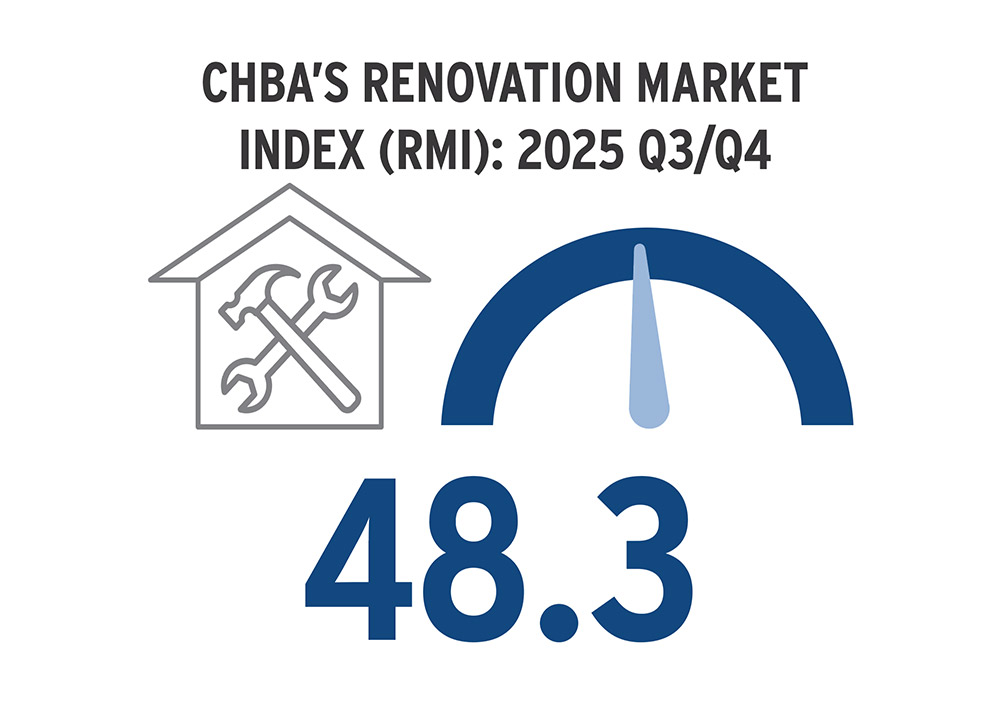
CHBA launched its inaugural Renovation Market Index (RMI) in late 2025, collecting a strong number of responses from renovator members across the country. Just like the HMI, CHBA modelled the RMI after a similar indicator used by NAHB in the U.S. that has been developed and used for years. This has enabled CHBA’s indices to be accurate and credible right out of the gate. The RMI survey asks renovators to rate the current business conditions for six major types of renovations as Good, Average or Poor. The survey then asks renovators to similarly rate their pace of inquiries and quotes, as well as the length of their current backlog. These two questions represent renovators’ future expectations. Just like the HMI, the RMI is a weighted average of current and future conditions, expressed as a number between zero and 100, where 50 represents neutral renovator confidence. A score further above/below 50 is expected to correlate with higher or lower renovation economic output growth over the near future.
The RMI for the second half of 2025 registered a score of 48.3 out of 100. This is close enough to 50 to represent a neutral score, with neutral overall current conditions weighed down by markedly pessimistic future conditions. The current conditions subindex, which is given a 75-per-cent weighting, was 52.7, and the future expectations subindex, which takes up the remaining 25 per cent weight, was 35.2. These results give forward guidance that renovation output growth in 2026 will likely not be too far off the one-per-cent growth that was experienced in 2025.
Given the large size of CHBA’s renovator membership and their active participation, CHBA has been able to parse the RMI into regional results as well. The RMI showed stronger sentiment in the Prairies (61.3) and Atlantic Canada (64.6), versus poorer scores in Ontario (46.1) and British Columbia (41.7). These scores are much higher than the current HMI, which is showing record lows overall due to extremely poor sentiment in Ontario and BC, but the regional variation trends in renovator confidence mirror that of the HMI. The RMI results show regional housing affordability conditions are reflected the health of demand for renovation services.
The special questions that were asked in the RMI give us additional insight into the industry. For example, interior renovation jobs are faring much better than exterior improvements in terms of demand.
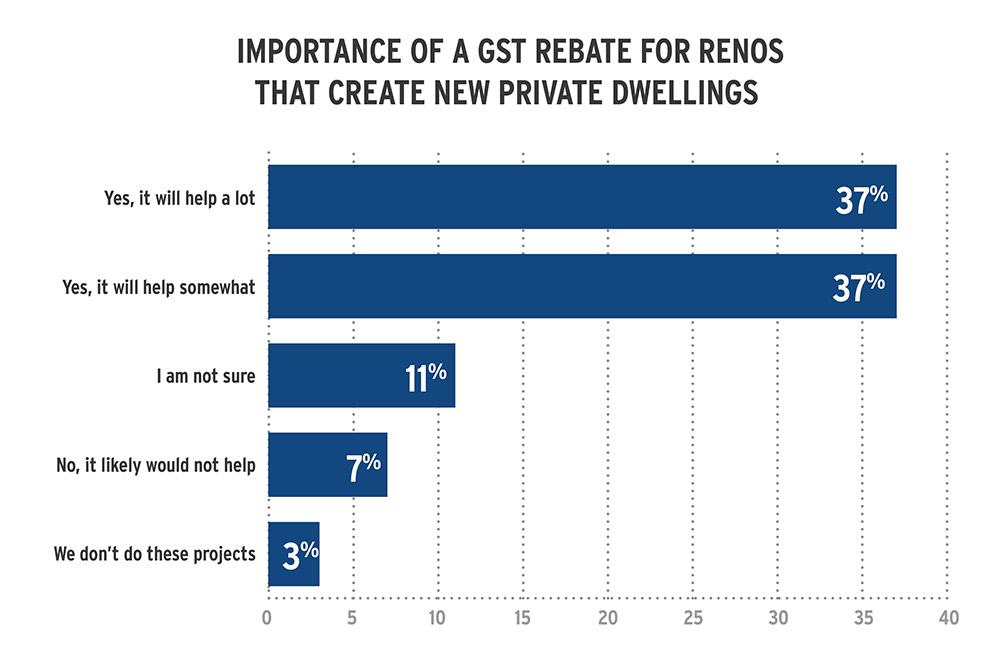
Accessory dwelling units (ADUs) are a growing segment of the industry as urban areas are finally allowing more infill projects to expand their housing stock. Under CHBA’s direct recommendations, Canada Mortgage and Housing Corp. (CMHC) now reports the number of urban accessory suite starts on a quarterly basis. In support of these kinds of developments and the renovators that build them, one of CHBA’s main policy recommendations is for the federal government to make GST relief applicable to renovations that add an additional unit of housing to existing homes, like ADUs and secondary suites. Among RMI respondents, 37 per cent of renovators said that this policy would help a lot, and another 37 per cent said it would help somewhat. CHBA also continues to push for the expansion of a full federal five-per-cent GST rebate for all buyers, not just first-time buyers.
If you are renovator member and would like to join the RMI survey panel, administered just twice a year, please email hmi@chba.ca to signal your interest.