






By Alireza Khalili, Director of Business Development, Promise Robotics
Across Canada, homebuilders are facing some of the toughest conditions in recent memory. To restore affordability, Canada Mortgage and Housing Corp. (CMHC) estimates we’ll need up to 4.8 million new homes by 2035. That means building between 430,000 and 480,000 units annually – nearly twice the current rate of around 245,000 starts. Traditional methods alone can’t meet that level of demand.
At the same time, labour shortages, unpredictable schedules, volatile material costs and the increasing pressure to deliver more homes faster are putting conventional site-built approaches under growing strain.
Countries such as Sweden, Germany and Japan have made meaningful progress with their own robust home-grown industrial backbones – showing that it’s possible to build faster, with greater precision and scale, through automation. Their progress offers valuable insight as Canadian builders explore more efficient, resilient ways to meet rising demand.

Why AI is changing the game
With nearly five decades of homebuilding experience – and more than 15 years in offsite manufacturing – we’ve had a front-row seat to the barriers that have long made automation feel out of reach for most builders. The capital intensity, system fragmentation and disruption risk have been real. But today, we’re witnessing a shift – and AI is at the centre of it.
Many still think of automation as expensive machinery and rigid programming. But by embedding artificial intelligence into the process, we’re seeing that automation no longer has to be massive or inflexible. AI allows us to reimagine what a factory looks like – and who can access its benefits.
From fixed automation to adaptive intelligence
One of the biggest historical barriers to automation in homebuilding is variability. Unlike manufacturing cars or electronics, no two building projects are exactly alike – each comes with its own building codes, designs and site conditions. Traditional factory automation was built for repetition, is not ideally suited for many variations in design.
AI changes that by making automation flexible and responsive. It interprets building models, understands building codes and adapts to real-world differences on the factory floor, creating a unique set of robotic manufacturing instructions for each home.
What makes this truly powerful is that the system learns and improves with every cycle. Over time, this continuous feedback loop boosts speed, accuracy and efficiency, turning automation from a rigid tool into a dynamic partner for modern builders.
AI is lowering the cost – and changing the economic viability of automation
Equally important is the economic shift AI enables. Historically, automation required costly, custom machinery and rigid production lines. AI flips that dynamic, making automation more affordable, compact and capable.
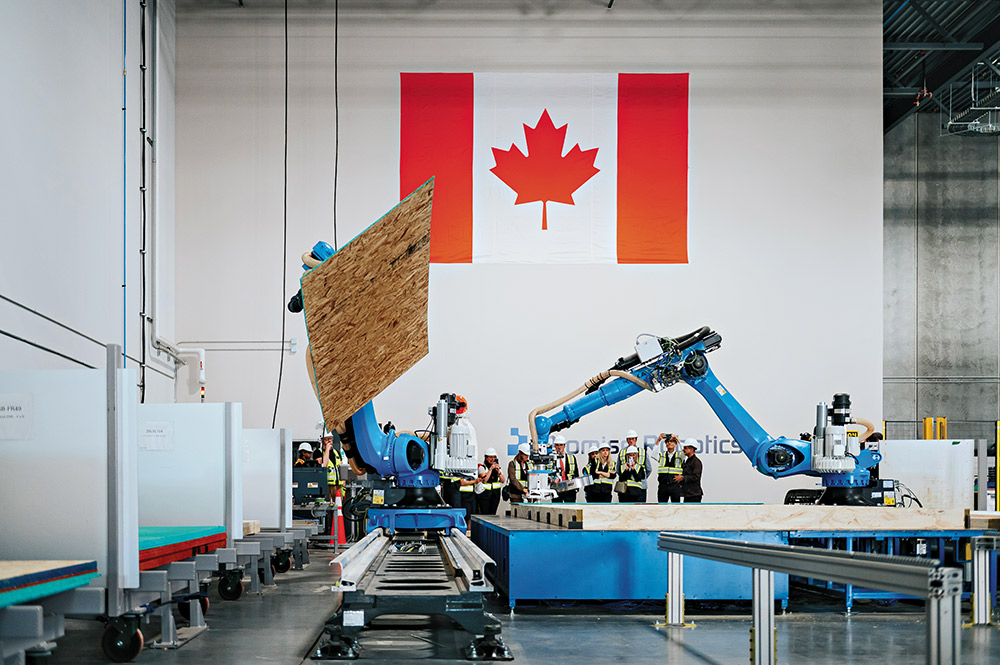
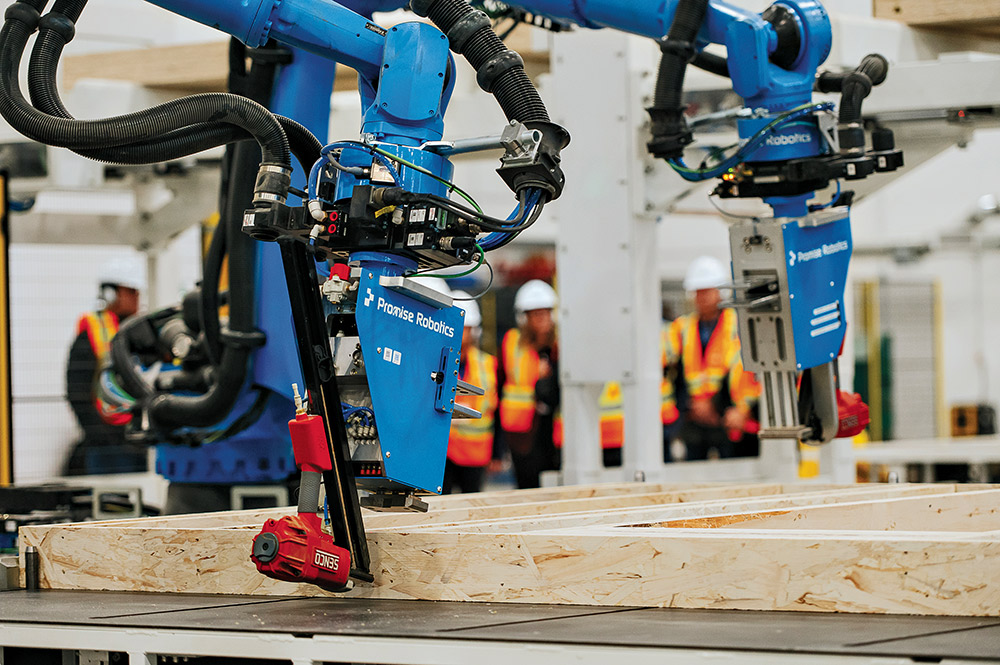
Rather than reprogramming equipment for each job, AI systems can analyze a building’s digital plans, optimize how to build it, and direct off-the-shelf robots to do the work. That reduces setup time from days to minutes and allows one robotic cell to handle multiple tasks – such as framing, glueing, sheathing or fastening.
The result?
• Lower capital costs for factories
• Faster deployment of automation
• Smaller production footprints closer to where homes are needed
• Greater flexibility and scalability for builders of all sizes
Forward-looking builders are looking beyond just immediate cost savings – they’re preparing for a more resilient, scalable future. One where operations can flex with market cycles and unlock higher productivity without sacrificing quality or design control.
Future-proofing: A long-term play for builders
In conversations with builders across Canada – whether high-volume or low – we’re seeing a shift in mindset. There’s growing urgency around cycle times and output, but more than that, there’s a clear focus on building long-term resilience. The question isn’t just “How do we build more?” – it’s “How do we stay competitive as the landscape changes?” For most builders, this isn’t about chasing a trend. It’s a deliberate investment in flexibility, control and future readiness.
Digitization is emerging as a key part of that conversation – going well beyond automation alone. For some, it starts with moving from static PDF plans to dynamic digital models. Others are beginning to connect those models to semi-automated offsite manufacturing processes. But for most, full digital transformation – and the advanced automation that comes with it – has felt out of reach.
That’s starting to change. AI is acting as a catalyst that makes this transition more accessible, flexible and rewarding. It brings the missing intelligence to automation, turning digital plans into machine-executable tasks, adapting to custom designs and local code requirements, and reducing the need for manual intervention.
And because AI systems continue to learn with every project, these benefits don’t just add up, they compound. Over time, each build helps create a smarter, faster and more resilient operation, helping builders stay competitive no matter how the market evolves.
Looking ahead: Canada’s AI advantage
As Canada faces one of the most significant housing shortages in its history, the opportunity to lead in AI-enabled construction has never been greater. We have the ingredients: World-class homebuilders, a growing base of offsite expertise, a rich supply chain and some of the best AI talent and investment ecosystems in the world.
The next generation of construction is being built right here – not just with steel and lumber, but with data, intelligence and experience. For builders ready to lead, the moment to act is now.
About Promise Robotics
Promise Robotics was built by builders, for builders. Our roots run deep in Canadian homebuilding, with 48 years of experience in residential construction and more than 15 years specializing in offsite manufacturing. Originating from one of Canada’s most experienced panelized homebuilding operations in Edmonton and Calgary, we’ve lived the realities of the job site, and we understand the practical challenges of scaling automation in real-world conditions.
Today, we’re using that experience to help solve Canada’s housing crisis. Our approach doesn’t just modernize old factory models – it leapfrogs them. By combining advanced AI and robotics with deep construction knowledge, we’re making high-performance, offsite homebuilding faster, more flexible, and more accessible than ever.
Promise Robotics is currently planning to expand operations in the Greater Toronto Area, bringing next-generation automation systems closer to one of Canada’s most critical housing markets.